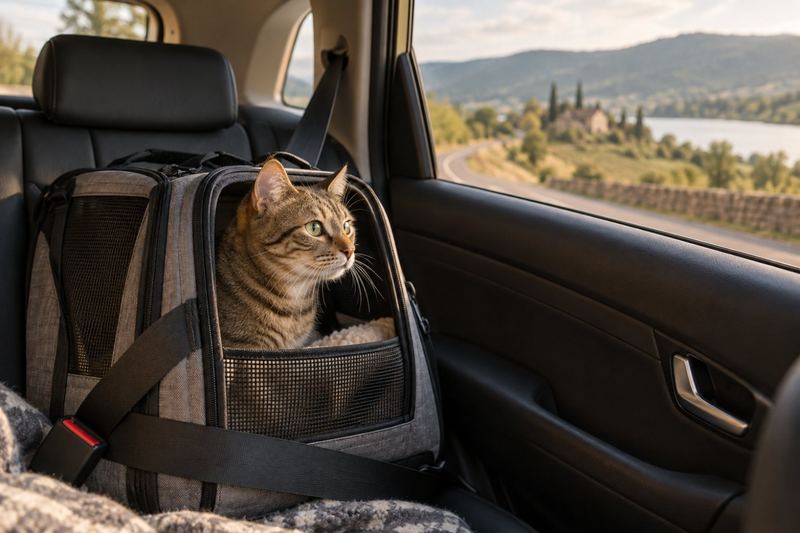
Yes, you can take a cat on a plane. Most US and European airlines let one cat ride in the cabin in a carrier under the seat in front of you, for a fee of about $50 to $150 each way in the US.
Key facts
- Most US airlines allow one cat per passenger in the cabin.
- US cabin pet fees range from $50 (Allegiant, per segment) to $150 (United, Delta, American, JetBlue) each way.
- At US security your cat comes out of the carrier and is carried through the metal detector.
- British Airways, Emirates and Qatar Airways don't carry cats in the cabin.
Airlines that take cats in the cabin
Cat-friendly airlines, with the one-way cabin fee each one publishes:
| Airline | Cabin fee, one way |
|---|---|
| Air Canada | C$50–60 Canada/US; C$100–120 international |
| Allegiant Air | $50 per segment |
| American Airlines | $150 per kennel, each way |
| Delta Air Lines | $150 US/Canada; $200 international |
| Frontier Airlines | $149 per pet, each way |
| JetBlue | $150 each way |
| Southwest Airlines | $125 each way; $35 between Hawaiian islands |
| United Airlines | $150 each way |
| WestJet | C$50–59 Canada/US; C$100–118 elsewhere |
| Air France | €200 US$225 on US–Europe routes |
| KLM Royal Dutch Airlines | €70–500 each way, by route |
| Lufthansa | Varies by route; not published |
| Turkish Airlines | US$75 published interline rate; varies |
Alaska Airlines and Hawaiian Airlines also take pets in the cabin, but their current pages we could read only mention dogs, so confirm cats with them before booking. British Airways, Emirates and Qatar Airways don't carry cats in the cabin.
Step 1: Book your cat right after you book yourself
Airlines limit how many pets can be in each cabin, often to a handful per flight, and it's first come, first served. Add your cat to the reservation as soon as you've bought your ticket. Some airlines let you do it online (United, JetBlue, Frontier, Turkish); others want a phone call (Delta, Air Canada, Southwest recommends calling).
Choose a nonstop flight if you can. Every connection means another security line, another boarding and, on some airlines, another fee.
Step 2: Get a carrier that fits the airline
A soft-sided carrier is the best choice for cats: it fits under seats more easily and Air Canada, Lufthansa and Turkish Airlines accept only soft-sided carriers in the cabin. Check your carrier against your airline's limit with the carrier size checker, or read our guide to carrier sizes.
Leave the carrier out at home for a week or two before the trip, with a familiar blanket inside, so your cat treats it as a safe spot rather than the box that means the vet.
Step 3: Plan for the airport
- Put a harness on before you leave home. At US security you take your cat out of the carrier and carry it through the metal detector while the carrier is X-rayed. A snug harness and leash stop a frightened cat from bolting.
- Ask about a private screening room. If your cat is nervous, ask the officer whether you can be screened somewhere quieter, where an escape wouldn't end in a busy terminal.
- Line the carrier. An absorbent pad in the bottom of the carrier deals with accidents. Pack spares, a few zip bags and wipes.
- Keep the carrier closed. Every airline we track requires your cat to stay inside the carrier, under the seat, for the whole flight.
Step 4: Keep the day calm
Most cats do better on a light meal a few hours before leaving than on a full stomach. Bring a little food and water for long days or delays.
Talk to your vet before the trip, especially about sedation. Many vets advise against sedating pets for flights, and some airlines won't accept sedated animals; American Airlines, for example, says so in its pet policy.
Flying internationally with a cat
Entry rules come from the destination country, not the airline. Many countries need a microchip, rabies vaccination and a vet health certificate issued within a set number of days before travel. Some, including the UK, don't allow pets to arrive in the cabin at all, which is why several airlines ban cabin pets on UK routes. Check the destination's rules before you book.
Questions people ask
Can you take a cat on a plane?
Yes. Most US airlines and many international airlines allow one cat per passenger in the cabin, in a carrier that fits under the seat in front of you. Fees range from about $50 to $150 each way in the US.
How much does it cost to fly with a cat?
In the US, cabin pet fees are $50 per segment on Allegiant, $125 on Southwest, $149 on Frontier and $150 on United, Delta, American and JetBlue, each way. Air Canada charges C$50 to C$60 within Canada and the US.
Does my cat count as my carry-on?
It depends on the airline. JetBlue, Southwest, Allegiant and American count the pet carrier as your personal item or carry-on. Air Canada and Frontier let you bring it in addition to your normal allowance.
Should I sedate my cat for a flight?
Ask your vet. Many vets advise against sedation for air travel, and some airlines, including American Airlines, don't accept sedated pets.