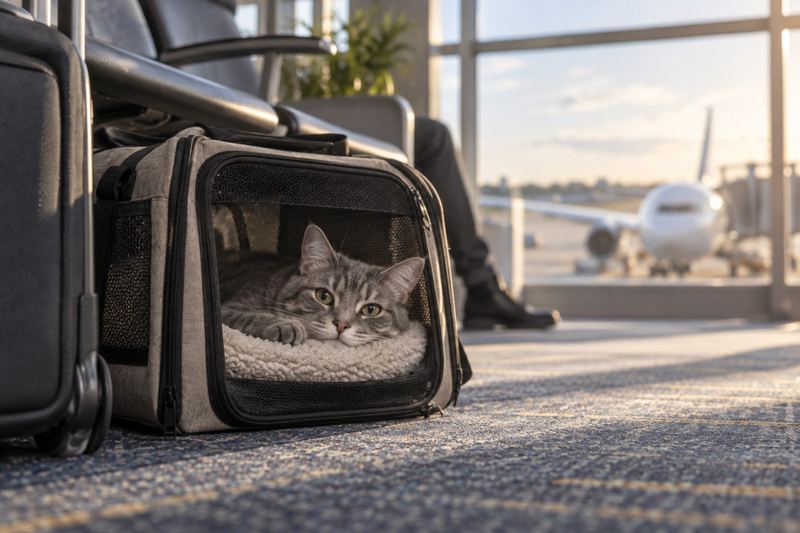
For a road trip with a cat, keep your cat in a closed carrier for the whole drive. Secure the carrier on the back-seat floor or with a seat belt, and never leave your cat alone in a parked car. Bring a small litter box and open the carrier only when parked with the doors shut.
Key facts
- The AVMA says cats should ride confined in a cage or carrier, not loose in the car.
- Feline vets (AAFP) say the safest spot for a carrier is on the floor between the front and back seats, and each cat needs its own carrier.
- A parked car's interior can heat up by about 19°F in 10 minutes and 29°F in 20 minutes, according to figures cited by the AVMA. Cracking the windows makes no difference.
- Each destination state sets its own pet entry rules. The AVMA says a health certificate is generally issued within 30 days before travel that isn't by air.
- The AVMA advises microchipping and registering your current contact details with the chip.
How do you travel long distance with a cat in a car?
Treat the carrier as your cat's seat for the whole trip. A loose cat can get under the pedals, block your view, get hurt by an airbag or be thrown in a sudden stop. The AVMA says to confine cats to a carrier, and recommends placing it near the middle of the car and securing it.
- Where to put it: the American Association of Feline Practitioners (AAFP) says the floor between the back and front seats is the safest spot. If the carrier rides on the back seat instead, thread the seat belt through its handle or strap so it can't slide or tip.
- Not in the front: keep the carrier off the front passenger seat, where an airbag can deploy.
- One cat per carrier: the AAFP says each cat needs its own carrier, even cats that get along.
- Which carrier: the AAFP calls hard plastic carriers the safest and easiest to clean. If you use a soft one, look for a large top opening and doors that stay open. It advises against backpack-style carriers and says a harness and leash alone isn't a safe way to travel.
If you also plan to fly, check the carrier against airline limits with the carrier size checker; our carrier guide explains what "airline approved" means.
How do I get my cat ready for a long car trip?
Most cats only ride in the car to go to the vet, so start with the carrier at least a couple of weeks before you leave:
- Leave the carrier open in a room your cat likes, with a familiar blanket inside, so it becomes a normal resting spot.
- Once your cat goes in on its own, close the door for short periods, then carry it around the house.
- Take short drives around the block and build up from there. The AVMA suggests getting your pet used to both the carrier and the car before a long trip.
On the day, the AAFP suggests covering the carrier with a blanket or thick towel to cut down on sights and sounds. Keep the car well ventilated at a comfortable temperature, and keep the radio and voices low. If your cat cries, talk to it quietly and don't open the carrier while you're moving.
How do you set up a travel litter box for a cat?
Most carriers are too small for a litter tray, so plan to offer the box at stops rather than during the drive:
- Use a small, lidded or disposable box that fits in the footwell or trunk, and bring the same litter your cat uses at home. A change of litter is an easy reason for a cat to refuse it.
- Offer it with the car parked and every door and window closed. Open the carrier inside the car, never outside it. A scared cat can bolt through a gap faster than you can react. A snug harness, put on before you leave home, gives you something to hold.
- Don't worry if your cat won't use it. Many cats hold on until the evening stop. Set the box up as soon as you reach the hotel.
- Line the carrier with absorbent pads and pack spares, wipes and bags for accidents.
When should I feed my cat on a road trip?
Keep to your cat's normal food. The AVMA suggests offering food and water in small portions on long trips. In practice, a light meal a few hours before you set off is easier on a cat that gets queasy than a full stomach. Offer water at stops, and give the main meal once you've stopped for the night. Bring enough food for the trip plus a couple of extra days in case of delays.
If your cat drools, vomits or panics in the car, talk to your vet before the trip. The AVMA notes that vets may prescribe medication for car sickness on long trips, depending on the pet's health. Don't give any medication without your vet's advice.
Can I leave my cat in the car for a few minutes?
No. The AVMA says never to leave a pet alone in a parked vehicle, whatever the weather or however short the stop. The figures it cites show a car's interior heating up by about 19°F in 10 minutes and 29°F in 20 minutes. On a 70°F day that can mean more than 110°F inside after an hour, and cracking the windows makes no difference. Cold is a risk too, especially for young, old, ill or thin cats.
Plan stops so someone can stay with the car, use drive-throughs, and pick up takeout rather than leaving your cat to eat inside.
How do I find a cat-friendly hotel?
"Pet friendly" often means dog friendly, so ask directly whether cats are accepted, how many pets are allowed and what the pet fee is. Cornell's vet school also advises checking fees before you book. Once you check in:
- Cat-proof the room before opening the carrier: check behind the bed, under furniture and around vents, where a frightened cat might hide.
- Set up the litter box, water and food in the bathroom, or keep your cat there with the door shut when you're going in and out.
- Put out the "Do not disturb" sign so housekeeping doesn't open the door while your cat is loose.
- Before you check out, count your cat back into the carrier before you pack the car.
Does my cat need ID or papers for a road trip?
ID matters more than papers. A cat that escapes at a rest stop is hundreds of miles from anyone who knows it. The AVMA recommends a current ID tag and a microchip registered with your home contact details. Add your cell number before you leave, and carry a recent photo and vaccination records.
For crossing state lines, the USDA says it doesn't regulate owners driving with their pets. Each destination state sets its own entry rules. The AVMA says a certificate of veterinary inspection, where required, is generally issued within 30 days before travel that isn't by air. Check the state you're moving to, especially Hawaii, and check the destination country's rules if you're crossing a border.
Is a train or plane easier than driving?
For a small cat on a shorter trip, sometimes. Amtrak takes cats up to 20 lb with the carrier on trips of up to 7 hours (see pets on trains), and most US airlines take a cat in the cabin. Our guide to flying with a cat covers fees and airport security.
Questions people ask
How long can a cat travel in a car?
There's no official limit. Many cats manage a full day's drive if they're secured in a carrier, kept at a comfortable temperature and offered water and a litter box at stops. If your cat is very distressed on short drives, ask your vet before planning a long one.
Can my cat ride loose in the car?
It's not safe. The AVMA says to keep cats confined in a carrier, because a loose cat can interfere with the driver or be injured by an airbag or in a sudden stop.
Should I sedate my cat for a road trip?
Talk to your vet. Only your vet can decide whether medication is right for your cat, and you shouldn't give any without their advice.
Do I need a health certificate to drive my cat to another state?
It depends on the destination state, which sets the rules. Ask your vet or the destination state's animal health office before you go.
Can I put the litter box in the carrier?
Usually there isn't room. Line the carrier with absorbent pads instead, and offer a small box at stops with the car doors closed.
Sources
- AVMA: Traveling with your dog or cat
- AVMA: Pet safety in vehicles
- American Association of Feline Practitioners: Getting your cat to the veterinary practice
- Cornell University College of Veterinary Medicine: Traveling safely with your dog: cars, planes and pet-friendly stays
- USDA APHIS: Take a pet from one U.S. state or territory to another