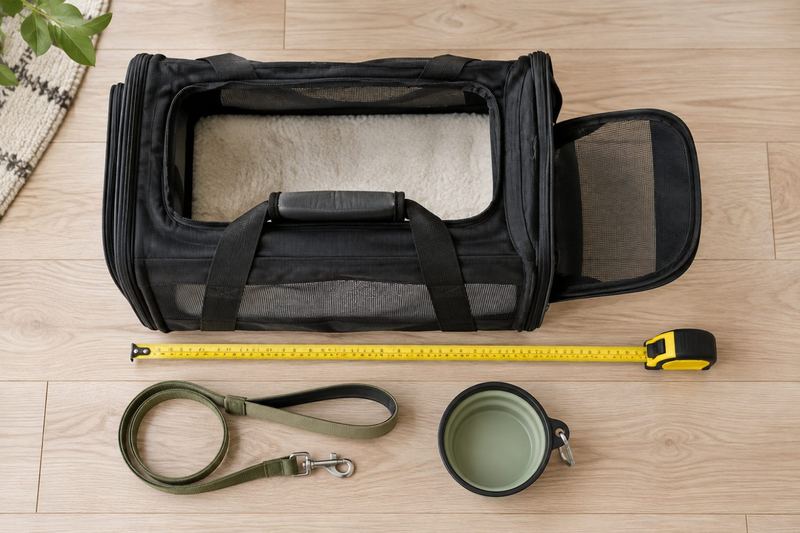
For air travel, your dog's crate size comes from four measurements of your dog, not its weight. Under IATA's rules, the crate's inside length must be at least nose-to-tail-base plus half the leg height, the width twice the shoulder width, and the height the standing height plus bedding.
Key facts
- IATA minimum inside length = A + ½B, width = C × 2, height = D (plus bedding).
- All four numbers are the crate's internal dimensions. Flat-faced breeds need a crate 10% larger.
- Wire-mesh, soft-sided and folding crates are not accepted for flights in the hold.
- American Airlines Cargo requires a metal door, metal bolts or screws, and ventilation on 3 sides (domestic) or 4 sides (international).
- Wheels must be removed or made inoperable.
Is there an airline approved dog crate?
Not officially. No agency certifies crates as "airline approved". A crate is accepted if it's big enough for your dog under the International Air Transport Association (IATA) Live Animals Regulations and meets your airline's construction rules. Airlines check both at the counter, and staff can refuse a crate that fails.
For dogs and cats, the IATA standard is Container Requirement 1 (CR1). You'll also see "CR82", which covers crates for strong or potentially dangerous dog breeds. Some airlines require it for those breeds, and some for large dogs in general, so check your airline before you buy.
How to measure your dog for a crate
Measure your dog standing naturally, on a flat floor, with a soft tape measure. If two dogs share a crate, measure the larger one.
- A: length from the tip of the nose to the base (root) of the tail.
- B: height from the floor to the elbow joint.
- C: width across the shoulders or the widest point, whichever is greater.
- D: height from the floor to the top of the head or the tip of the ears, whichever is higher, standing naturally.
The IATA crate size formula
IATA gives these minimum internal dimensions for one dog:
| Crate dimension | Formula |
|---|---|
| Length | A + ½B |
| Width | C × 2 (two animals: C × 3; three animals: C × 4) |
| Height | D, plus the height of any bedding |
Snub-nosed (brachycephalic) breeds need a container 10% larger. Many airlines don't fly these breeds in the hold at all; see our guide to snub-nosed dog breeds and airlines.
American Airlines Cargo publishes the same formulas, with height simply as D. It also caps bedding at 3 inches, so allowing for it is easy.
A worked example
Say your dog measures A = 24 in, B = 10 in, C = 8 in and D = 22 in. The minimum inside crate is:
- Length: 24 + 5 = 29 in
- Width: 8 × 2 = 16 in
- Height: 22 in, plus bedding
Our dog crate size calculator does this math for you in inches or centimeters.
The rule of thumb at the counter, from American Airlines Cargo: no part of your dog should be taller or longer than the crate when standing beside it, and its ears shouldn't touch the top. Your dog has to be able to stand, sit upright, turn around and lie down naturally.
Dog crate size chart: common airline crate sizes
Travel crates are sold in a numbered series. American Airlines Cargo publishes these external dimensions for the common sizes:
| Name | Type | External L × W × H (in) | External (cm) | Crate weight |
|---|---|---|---|---|
| Small | 100 | 21 × 16 × 15 | 53 × 41 × 38 | 7 lb (3 kg) |
| Medium | 200 | 27 × 20 × 19 | 69 × 51 × 48 | 13 lb (6 kg) |
| Intermediate | 300 | 33 × 22 × 23 | 84 × 56 × 58 | 18 lb (8 kg) |
| Large | 400 | 36 × 24 × 26 | 91 × 61 × 66 | 24 lb (11 kg) |
| Extra Large | 500 | 40 × 27 × 30 | 102 × 69 × 76 | 32 lb (15 kg) |
| Giant | 700 | 48 × 32 × 35 | 122 × 81 × 89 | 51 lb (23 kg) |
Source: American Airlines Cargo kennel guidelines. AA Cargo accepts the 100 size on domestic flights only, and the 500 and 700 sizes only on its expedited service.
These are outside measurements. The IATA formula gives inside measurements, which are smaller because of the walls, the door and the roof shape. Get the internal dimensions from the manufacturer, compare them with your formula result, and if your dog falls between two sizes, choose the larger one. In the example above, a crate needs at least 29 × 16 × 22 in inside, so a 300 crate (33 × 22 × 23 in outside) is likely too low once you allow for walls and bedding.
What does an airline crate need?
Size is only one check. These construction rules come from IATA and American Airlines Cargo; other airlines use very similar lists.
- Material: rigid plastic, metal, wood or fiberglass. Crates made entirely of wire mesh, soft-sided crates, wicker, cardboard and folding or collapsible crates aren't accepted.
- Door: AA Cargo requires a metal door covering one end. No doors on top. IATA requires locking pins to go at least 1.6 cm into the frame.
- Fasteners: plastic clips can't be the only thing holding the top and bottom together. AA Cargo accepts snap-closure crates only when they're also secured with metal nuts, bolts or screws.
- Ventilation: AA Cargo requires openings on 3 sides for domestic flights and 4 sides for international flights. IATA requires ventilation on all four sides, at least 16% of their total area. Openings for dogs can be no bigger than 1 × 1 in at AA Cargo.
- Wheels: removed or made inoperable.
- Floor: solid and leak-proof, with absorbent bedding. AA Cargo bans hay, straw and wood shavings and limits bedding to 3 inches.
- Bowls: separate food and water dishes fixed inside, which can be filled from outside without opening the door.
- Labels: a "Live Animals" label and "This Way Up" arrows. Airlines usually provide these at drop-off.
Some airlines go further. Croatia Airlines, for example, doesn't accept standard plastic crates for dogs over 18 kg, including the crate. Lufthansa introduced stricter container rules from May 4, 2026. Always read your airline's own page.
How large can an airline crate be?
There's a limit set by the aircraft. KLM accepts crates up to 122 × 81 × 89 cm, the same as the 700 size, but only 102 × 69 × 76 cm on certain Boeing 737 and Embraer flights. American Airlines Cargo only takes the two largest sizes on its expedited service. A crate that doesn't fit through the cargo door won't fly, however well it's built.
Airlines also cap total weight. Alaska Airlines accepts dog plus crate up to 150 lb, Air Canada up to 45 kg (100 lb), and Air France and KLM up to 75 kg (165 lb). Remember to add the crate's own weight from the table above. For booking and fees, see flying pets in cargo.
Getting your dog used to the crate
Buy the crate weeks ahead. Leave it open at home with familiar bedding so your dog chooses to rest in it. Fit the bolts, cable ties and bowls before travel day so nothing is new at the airport. If you're worried about your dog's stress, talk to your vet.
Questions people ask
What size crate does my dog need to fly?
Measure your dog and use IATA's formula: inside length at least nose-to-tail-base plus half the elbow height, inside width twice the shoulder width, and inside height at least the standing height to the head or ear tips, plus bedding.
What size crate for a 40 lb dog?
Weight doesn't decide crate size; body measurements do. Two dogs of the same weight can need different crates, so measure yours and compare the result with the crate's internal dimensions.
Can I use a wire crate on a plane?
No. IATA says crates made entirely of welded or other wire mesh must not be used for air transport. Wire is only allowed as part of a rigid crate, such as a metal door.
Does the crate size include the outside or inside?
IATA's formula gives the minimum inside dimensions. Crate size names and charts usually list outside dimensions, so check the manufacturer's internal measurements.
Do I need a bigger crate for a bulldog or pug?
Yes. IATA requires a container 10% larger for snub-nosed breeds, and many airlines won't carry them in the hold at all.
Sources
- IATA: Traveling with pets
- IATA: Live Animals Regulations, Container Requirement 1 (52nd edition, 2026)
- American Airlines Cargo: Kennel guidelines
- American Airlines Cargo: Kennel requirements (PDF)
- Croatia Airlines: Animals
- KLM: Travelling with pets
- Lufthansa: Animals as excess baggage
- Alaska Airlines: Traveling with pets
- Air Canada: Travelling with pets
- Air France: Traveling with your dog or cat